Crimping Grain with Magniva Platinum Crimp
16th July 2026
Home grown crimped grain can be a highly effective way to preserve cereals at harvest, reduce bought in feed costs and provide a high energy ingredient for ruminant diets when forage quality or quantity is under pressure. When harvested and stored correctly, crimping allows cereals to be taken earlier than conventional combining, while treatment with Magniva Platinum Crimp is designed to improve fermentation, reduce heating and limit spoilage at feed out.
Crimping cereal grain involves harvesting at higher moisture, rolling the grain to crack the seed coat, and then storing it anaerobically in a clamp so that it ferments and preserves safely. This approach creates a nutrient dense feed that can help balance grass silage diets and improve the use of home-grown cereals on mixed and livestock farms.
The main advantages of crimping include:
- Earlier harvest, typically around 2 to 3 weeks before conventional combining.
- Reduced drying costs compared with storing dry grain.
- The opportunity to preserve a high energy feed on farm for later use.
- Higher feeding potential due to a steadier release of fermentable energy in the rumen.
Cereals are generally ready to crimp when the grain is difficult to squeeze between thumb and forefinger, and thumbnail pressure just leaves an indentation in the grain. Where around 70% of grains meet this description, average crop moisture is usually in the 25 to 40% which is considered suitable for crimping.
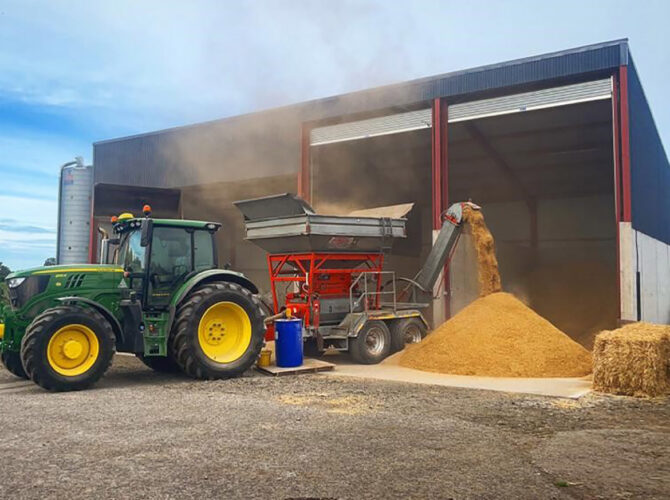
Once cut, the moist grain is passed through a crimping machine where rollers crack the grain and expose the carbohydrate rich endosperm to support effective fermentation. At this point the additive should be applied evenly to the grain as it leaves the crimping machine, so the inoculant is distributed through the material before ensiling.
For best results, the treated grain should then be:
- Placed quickly into a lined clamp.
- Layered evenly.
- Rolled into a wedge, as for grass silage, to exclude air.
- Sealed and well weighted immediately after filling.
Attention to clamp management remains critical, because even the best additive cannot compensate for poor consolidation or oxygen ingress after filling.
Magniva Platinum Crimp is formulated specifically for fermented crimped grains and contains a combination of bacterial strains selected to support both rapid preservation and improved aerobic stability after opening. It contains Pediococcus pentosaceus to drive initial fermentation, alongside Lactobacillus buchneri and Lactobacillus hilgardii to improve aerobic stability and inhibit spoilage organisms. This combination is important because crimped grain is vulnerable to heating and spoilage due to its high dry matter and starch content. Magniva Platinum Crimp is intended to address that challenge by increasing aerobic stability after opening, reducing dry matter losses, lowering heating risk and reducing contamination with yeasts and moulds.
Crimped grain can be a useful home grown concentrate for dairy and beef systems, particularly where there is a need to supplement lower energy forage with additional starch and fermentable energy. Because preservation quality affects both feed value and waste levels, the combination of correct harvest timing, accurate processing, good clamp management and a specialist inoculant is what ultimately determines the success of the system. To find out more about crimping grain or other grain preservation methods contact your local Fane Valley Agronomist or call 028 9261 0485.